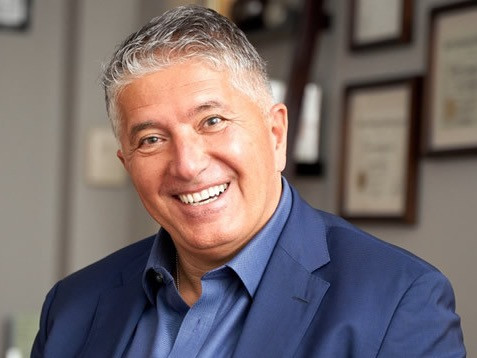
Ismar Volić is a full professor of mathematics at Wellesley University in Boston and one of the founders of the Institute for Mathematics and Democracy.
"It is increasingly difficult to recognize distorted or false information, but the more we learn to recognize it, the fewer there will be; this is the only way to eradicate quantitative manipulation. We must learn to be constantly critical of information and to question its validity, said, among other things, in a big interview for BUKA, the distinguished professor of mathematics from Boston, Ismar Volić. In ours, it is necessary to insist on transparency and education about basic democratic processes, such as voting and the allocation of seats in parliament. Dear Professor Volić, you and your colleagues recently founded the Institute for Mathematics and Democracy, which is dedicated to education, research, and spreading awareness about the role of mathematics in politics. How did you come up with this idea and to what extent are ordinary US citizens aware of the close connection between mathematics and politics, that is, to what extent are they quantitatively literate? Since I have been involved in mathematics, I have been interested in its role in society. However, what ultimately motivated me to found the Institute for Mathematics and Democracy was the political situation in America, where aggressive and destructive populism has declared war on critical thinking, facts, and science. Rationality and information are not in favor of the system that currently leads America, and the foundation of that rationality is quantitative literacy. Mathematics is thus indirectly under attack, so my colleagues and I feel the need to defend it through, as you said, education, research, and awareness of the role of mathematics in politics. And not only to defend it, but to turn it into a tool that will enable citizens to become educated and objective participants in the democratic process. In certain parts of America, people are quite quantitatively literate because interdisciplinary STEM education has existed as an integral part of the education system there for several decades. However, the focus of STEM education is mainly on engineering, technology, and computer science. There is no awareness that politics is also largely driven by quantitative processes and that education in these areas is also necessary. There are two different aspects of the interaction between mathematics and politics. One is political quantitative literacy, which would enable people to think critically about the information, numbers, and statistics that politicians and political organizations bombard them with. The second is education in mathematics, which is behind fundamental democratic processes such as voting, allocation of parliamentary seats, division into districts, etc. Both types of education are crucial for people to become effective participants in democracy, and both can be easily introduced into the curriculum. And what is the situation with the quantitative literacy of the citizens of Bosnia and Herzegovina, to what extent are they unfamiliar with the mathematics behind various socio-economic and political processes, and how inclined are they to think critically and question the information that is served to them? It seems to me that the situation regarding political quantitative literacy in BiH is similar to that in America, probably even worse because our educational system has an even weaker tradition of integrating critical thinking into the curriculum. The PISA test recently confirmed this. Without the general strengthening and nurturing of critical thinking, there can hardly be a critical attitude toward the quantitative aspects of politics. Even more broadly, there can hardly be a critical attitude towards any information that people come into contact with. A witness to this is the proliferation of conspiracy theories that seem to have taken deep root in our country. But I am an optimist, simply because in my work in BiH I constantly come into contact with incredible people. Students who could easily study at my college in Boston, professors who do cutting-edge research, educators who follow global pedagogical trends, administrators who understand that our education system must be reformed, people in non-governmental organizations who tirelessly fight for our children—everyone invests a lot of energy to educate people, to raise education to the world level. As long as there are such people, there is hope. What are the most obvious examples of politicians abusing numbers and statistics, and misleading citizens? Currently, the most obvious examples are related to the pandemic. Here in America, Trump has been trying for months to verbally minimize the impact and consequences of the coronavirus because the catastrophic economic situation caused by the pandemic is not in his favor. A few days ago, for example, he said that America "has more cases of coronavirus only because more tests are being done." A quantitatively literate person would ignore this irrelevant information and demand to know what percentage of those tested are positive. If the percentage goes up, then the pandemic is spreading, and that's exactly what's happening in America. In the same interview, Trump claimed that America has the lowest percentage of deaths from COVID-19 in the world. A quantitatively literate person would want to know the percentage of what? Trump gave the percentage of deaths concerning the number of infected; however, if you take the number of deaths as a percentage of the entire population, which is a much more informative measure of the presence of the pandemic, America is one of the worst countries in the world. Such examples, unfortunately, abound, both in America and in Bosnia and Herzegovina. Every sphere of politics—the economy, education, immigration, climate change—seems to be saturated with selectively presented statistics, numbers served up without explanation and questionable methodologies. It is increasingly difficult to recognize distorted or false information, but the more we learn to recognize it, the fewer there will be; this is the only way to eradicate quantitative manipulation. We must learn to be constantly critical of information and question its validity. Mathematics is directly related to the election process. I assume that it starts already with the election campaign, because statistics play an important role there, and thus can significantly influence the electorate. In America, and I think this is also the case here, the distinction between when there is a campaign and when it is not mostly no longer exists. Politics is directed towards the self-preservation of politicians and calculating the consequences for the next election, be it tomorrow or three years from now. Polls are constantly conducted, data is constantly collected, and voters are categorized by various parameters and then selectively given carefully packaged information that shapes their opinion with surgical precision. Modern statistics and mathematics enable rapid analysis of data and thus, unfortunately, give politics an effective weapon for voter manipulation. This is most evident in social media, where people can easily be politically profiled and compartmentalized to be directly influenced and tailored to their needs. In most election processes, including in BiH, a relative majority is used - the candidate with the most votes wins. The relative majority, as you said in the recently held webinar, is problematic for several reasons, and as an example, you cited Trump's victory, but also the victory of Džaferović in the 2018 elections for the Bosniak member of the BiH Presidency, where he was not the first choice for 63 percent voters. Why are these examples that illustrate the problematic nature of the relative majority? Whenever a relative majority is used, in which one candidate is voted for and the person with the most votes wins, there is a danger that a candidate who does not represent the true preference of the voters has been elected. If the winning candidate has less than 50% of the vote, it means that the majority of voters do not have that candidate as their first choice. In other words, the winning candidate wins a minority of votes, and by winning, he becomes someone who represents all voters. For example, in the 2016 presidential race for the Republican Party in America, Trump won with 45% of the vote. Polls later showed that Republican voters would prefer any of the other three major Republican candidates to represent their party. But those three candidates dispersed the other 55% of the vote, allowing Trump to win. A similar thing happened in the US presidential election of 2000, in which George Bush defeated Al Gore, simply because the vote was by a relative majority. Unfortunately, this is a regular phenomenon in the world, including here. As you mentioned, Džaferović won in the last election with 37% of the vote, which means that there is a possibility that a large number of the other 63% of voters, if they had the opportunity to express their preference, might have united behind another candidate. That second candidate would then perhaps represent the absolute majority of voters, which is a much better situation. What is a fairer solution? Relative majority is one of the worst electoral methods from a mathematical point of view because it does not take true preferences into account. This method only knows who the voter's first choice is but does not know what the voter thinks about the other candidates. There are better, so-called preferential methods by which voters rank all candidates. In one of the most popular such methods, Hare's method, the winner is decided by successively eliminating the candidates with the least first votes, based on the ranking, and after each round of elimination, the votes are tabulated. The winner according to this system is not always the candidate who initially received the most first places, but the one who is the most optimal for the largest number of voters, meaning the candidate who best represents the consensus. This method is much fairer, eliminates the possibility of vote dispersion and other negative effects of the relative majority, and represents the true choice of voters in a much better way. The reasons why the relative majority is used at all have nothing to do with the quality of this type of voting, but with inertness and a lack of education: it is the simplest method, it has been around for a long time, voters do not know that there are better systems, so they do not protest, and it also favors the big parties, so it is not in their favor to change it. Hare's method is used all over the world and is increasingly popular in America as well. Many cities already use it, and on the November ballot, we will be asked in my state of Massachusetts if we want to implement it. I am confident that this initiative, supported by the Institute for Mathematics and Democracy, will pass and that Massachusetts will join the ranks of places where voting makes more mathematical sense. You have also come to know that the allocation of mandates in the Parliament of Bosnia and Herzegovina is based on a formula that no one in the area, or even beyond, uses. What is disputed here: the formula itself or the fact that probably hardly anyone in BiH knows about this method, its advantages or weaknesses? The so-called Sainte-Laguë method is used to allocate seats in the parliaments in BiH. Our neighboring countries use the D'Hondt method, which is generally more prevalent in the world. The methods are similar, but both favor large parties. For example, in the last elections, the SDA received 25.25% of the votes, and it has 27.55% of the seats in the parliament of the Federation of Bosnia and Herzegovina. In the RS Assembly, SNDS won 31.87% of the votes and has 33.73% of the seats. But the main problem is not even the method itself, but the fact that in our country it is difficult to get information about such things. It took me a long time to find something about the allocation of parliamentary seats, and as far as I could see, there is no explicit mention of Sainte-Laguë anywhere. What is lacking is transparency and education about basic democratic processes, such as voting and seat allocation. In a politically quantitatively literate society, citizens would know to ask the question of who and when decided to use certain methods and who profits the most when they are used. People would know that better, more representative methods exist and would be empowered to demand that existing processes be changed to ones that the math says represent a fairer practice of democracy. What are some examples of political systems that have better electoral processes? Many countries, such as Australia, Canada, New Zealand, England, Ireland, Scotland, and India, use preferential voting systems. Preferential methods are also used in hundreds of cities and local elections around the world, and often in organizations, companies, and universities. Therefore, there are examples all around us. Awareness that this is a better way of voting is growing, and initiatives to eliminate the relative majority and replace it with preferential methods are increasing. And finally, how to quantitatively literate people, should this segment be part of the education system? Of course, that segment should be an integral part of the educational system that fosters critical thinking and interdisciplinarity and gives children the confidence to become informed participants in democracy and agents of political and social change. STEM education is key in this, and as its crucial component, political quantitative literacy, should be enforced, children should learn from relevant examples from real life that include the socio-political context. It is very easy to insert examples of various voting systems or the allocation of parliamentary seats into the curriculum to illustrate why some are better than others and to show children how to critically treat statistics and to recognize false information from a quantitative aspect. These are topics that are available to high school students, even younger students. Unfortunately, PISA testing has shown that critical thinking is not developed in our school system. But at the same time, such results should be a motivation and an opportunity to reform education because, as we all know, without quality education, we will never achieve development and progress. Unfortunately, the authorities, who do not care about education or progress and who have been pushing children into cages for decades to make them obedient voters, continue to persist with their selfish, megalomaniac, and testosterone policies. As the last example of this, the PISA tests in 2021 will not be held in Bosnia and Herzegovina. Sad and devastating. But as I said earlier, what gives me hope are the wonderful, smart, energetic people all over the country who don't give up. As long as they continue their fight, I stand with them. Ismar Volić is a full professor of mathematics at Wellesley University in Boston and one of the guest lecturers at the Interdisciplinary Doctoral Studies in Global Studies at the Center for Interdisciplinary Studies of the University of Sarajevo. He graduated from Boston University and then earned a doctorate in mathematics from Brown University. He was a visiting professor at MIT, the University of Brussels, and the University of Virginia. His research area is algebraic topology. He is the author of thirty papers and two books, the editor of several collections of papers, and he has given over 200 lectures in twenty countries. He is one of the founders of the Institute for Mathematics and Democracy, which is dedicated to education, research, and spreading awareness about the role of mathematics in politics. (https://6yka.com/)
 English
 Bosanski